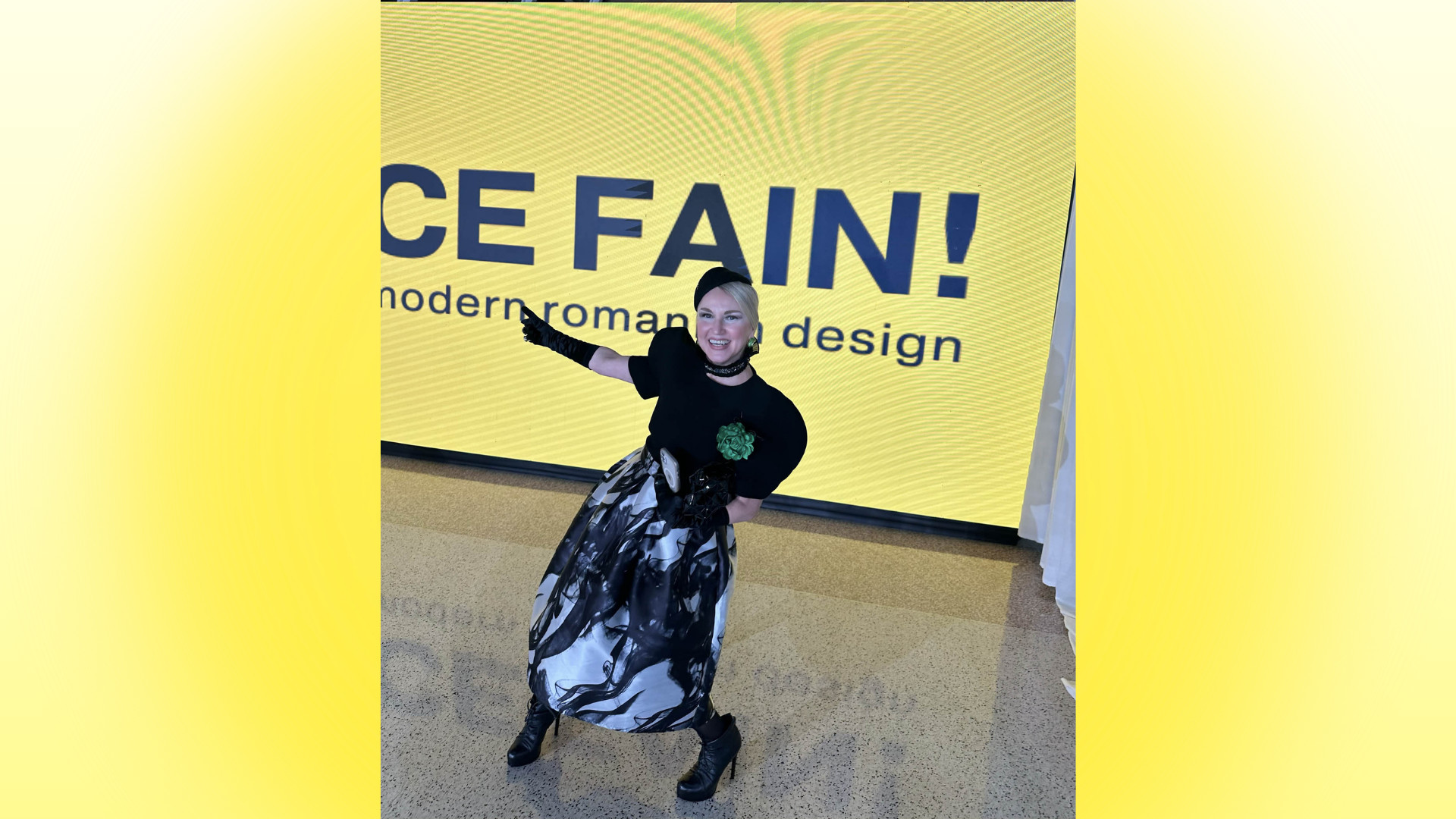
Ce Fain! at DC Fashion Week
The Room That Changes the Conversation
Washington, DC is not (yet) where fashion trends are made. That's the point.
New York sets the commercial tempo. Los Angeles produces the spectacle. But DC operates on a different register, one where influence moves through institution, through diplomatic relationship, through the slow, deliberate accumulation of credibility. When Ce Fain! arrived at DC Fashion Week with a booth full of contemporary Romanian design, it wasn't chasing visibility for its own sake. It was stepping into a room where the people who shape taste, policy, and cultural investment come to pay attention.
That's a different kind of opportunity. And Ce Fain! knew exactly what to do with it.
Why DC Fashion Week
Fashion weeks in smaller markets can easily collapse into self-celebration: community events dressed up in industry language, attended mostly by the already-converted. DC Fashion Week resists that gravity. It draws an audience shaped by the city itself: embassy communities, East Coast cultural tastemakers, institutional buyers, press with an appetite for design that carries a story beyond seasonality. The event sits at the intersection of diplomacy and aesthetics, and for a platform like Ce Fain!, which is building a bridge between Romanian design and the American luxury consumer, that intersection is precisely where the work needs to happen.

There was also something fitting about the geography. Washington has a long relationship with Romanian cultural life in America. The city holds institutions, communities, and cultural programming that have kept that relationship active and serious. Showing up here, at this event, was a way of locating Ce Fain! within a conversation that already has depth, rather than starting from scratch.
The Booth as Editorial Statement
Ce Fain! presented as a vendor booth, which is worth taking seriously as a format. A booth is not a runway. It doesn't give you the authority of distance and lighting and a curated procession. It gives you proximity. Conversation. The chance for a buyer to touch the fabric, ask about the maker, and understand what they're actually looking at.

What Ce Fain! brought to that proximity was deliberate. The pieces on display spanned the full range of what the platform curates: the ie, the traditional Romanian blouse reinterpreted through a contemporary silhouette, rendered in crisp white with intricate black lacework at the collar; a hand-embroidered outerwear jacket in saturated folkloric pattern, worn on the mannequin with the assurance of something that knows it belongs in the present tense; jewelry, textiles, and objects that shared a common quality of material seriousness.

Nothing that looked like a souvenir. Nothing that asked the viewer to bracket their taste in order to appreciate it.
That last point is Ce Fain!'s central editorial argument, and it held up in person in a way that digital presentation can only partially convey. Romanian design, at its best, does not ask for cultural accommodation. It asks for attention. The work shown at DC Fashion Week rewarded that attention.
What Romanian Design Looks Like When You Stop Explaining It
There is a version of presenting non-Western design traditions that is essentially defensive: here is the context, here is the history, here is why this matters despite being unfamiliar. Ce Fain! has made a deliberate choice to refuse that frame.
The craft traditions behind what was on display at DC Fashion Week are substantive. Romania has one of Europe's most technically accomplished textile and garment-making lineages. The geometric precision in Transylvanian embroidery, the formal intelligence that runs from Brâncuși's sculpture to contemporary Romanian jewelry design, the sheer density of skill embedded in a hand-worked piece that took weeks to complete: these are not charming footnotes. They are the foundation of a design tradition that produces work of international caliber.

What Ce Fain! showed in DC was what happens when that foundation is given a contemporary vocabulary and a room that doesn't require the preamble. The jacket didn't need an explanation. The ie didn't need to be historicized. They stood on their own terms, and the room responded accordingly.
Conversations at the booth skewed toward two registers: buyers who wanted to understand the acquisition path for specific pieces, and cultural and industry figures who wanted to understand Ce Fain! itself, the platform's model, its curatorial standards, where it's heading. Both kinds of engagement are meaningful. Together, they confirm something Ce Fain! has been building toward: a reputation as both a commercial venue and a cultural authority, and the sense that those two things are not in tension here but are, in fact, the same thing.
The Audience in the Room
One of the more striking aspects of DC Fashion Week as an event is its genuine international character. The attendees who moved through the booths and filled the runway seats brought with them the kind of personal style that signals real engagement with fashion as a language, not a costume. Traditional dress from multiple cultural traditions sat alongside contemporary editorial looks. The range was wide enough that no single aesthetic dominated, which created an unusual kind of fairness: every piece had to earn its moment without the assistance of a dominant cultural reference frame.

Romanian design fared well in that context. The pieces read as luxury-contemporary to viewers who had no prior relationship with Romanian craft traditions, which is a meaningful test. It means the work communicates on its own visual terms, that Ce Fain!'s curation is producing something legible to the international buyer rather than only to the already-initiated. That's the proof of concept the platform needed from its first significant public showing.


What Comes Next
Ce Fain!'s forward program is built around a question that the DC Fashion Week booth put into sharp relief: what does it look like when Romanian design is not explained but simply presented, at full quality, to an audience that's ready?

Form & Flight, the platform's 2026 curatorial initiative, takes that question as its organizing principle. The program invites Romanian designers to create original work in dialogue with two of Romania's most globally resonant figures: sculptor Constantin Brâncuși, whose 150th birth anniversary falls this year, and Nadia Comăneci, whose perfect 10 in Montreal turns 50 in 2026. The shared values of those two icons, discipline, balance, courage, and timelessness, become the creative brief. Designers select their interpretive path: FORM, drawing on Brâncuși's reductive geometry; FLIGHT, drawing on Comăneci's precision and elevation; or the dynamic equilibrium of both.
The program unfolds across four quarterly capsule launches in 2026, with each collection adding to a body of work that treats Romanian design as a living, forward-moving practice rather than a catalogue of heritage. The point is not nostalgia dressed in contemporary packaging. It is genuinely new work, made by designers who understand both their tradition and their moment.
DC Fashion Week was Ce Fain!'s introduction to the American stage. What it demonstrated, clearly, is that the introduction was worth making. The platform arrived with work that deserved the room. The room noticed. The next question is what gets built from that attention, and Ce Fain!'s answer to that question will define what this platform becomes.
Form & Flight launches in 2026. The story is just beginning.
Ce Fain! is a curated U.S. marketplace for contemporary Romanian design. Explore the current collection at cefain.com.


%20where%20fashion%20trends%20are%20made.%20That's%20the%20point.%0ANew%20York%20sets%20the%20commercial%20tempo.%20Los%20Angeles%20produces%20the%20spectacle.%20But%20DC%20...)