The Architecture of Desire: Haute Cuir Arrives on Ce Fain!
On leather, labor, and what it means when a Romanian atelier sets its sights on the world.
There is a moment in every serious collector's life when they stop buying clothes and start acquiring objects. The distinction matters. Clothes fill a wardrobe. Objects fill a life — they accumulate meaning, they resist disposal, they become the kind of things you explain to strangers at dinner parties and then immediately regret explaining, because the explanation is never quite right. How do you convey what it feels like to fasten a perfectly weighted leather belt at the waist and feel the day reorganize itself around you? You don't. You simply wear it.
This is the register in which Haute Cuir operates. And it is precisely why the Romanian leather accessories brand has found its way to Ce Fain! — not as a product listing, but as an argument.
A Beginning That Looks Like Fate
Designer and co-founder Dragos Aiacoboaie will tell you, with the practiced modesty of someone who has clearly thought hard about origin stories, that it started with curiosity. He was nineteen the first time he worked with leather — young enough to be surprised by how much he liked it, old enough to understand that liking something that much is a kind of instruction. What followed, in his words, was "a continuous period of joy, development and discovery." That sentence, sparse and precise, tells you something about how he makes things.

Born out of passion for leather crafting and fashion, Haute Cuir is an independent brand specialised in making leather accessories. The atelier, established in Romania, is the place where the art of leather crafting and high quality materials are brought together to create exquisite designs. But the chronology behind that clean sentence is richer than it suggests. Aiacoboaie began making accessories for himself and people around him as a teenager — an origin that is less artisanal mythology and more honest report of what happens when an obsessive creative mind encounters a material that doesn't lie. Leather doesn't forgive errors of attention. You have to mean it every time.
The brand's evolution mirrors a broader pattern in Romanian independent design: slow, deliberate, rooted in craft before commerce. The turning point came in 2017, when the brand joined Etsy and started sharing its work online. Soon enough, more and more people started buying — which motivated Aiacoboaie to develop his skills further. What began as a curiosity became a hobby, then a part-time occupation, then a full workshop. This is not the story of a venture-funded brand launch. It is the story of a craftsman who got very good at something and then found the world ready for it.
Black Leather and the Grammar of Power
There is an aesthetic philosophy embedded in every Haute Cuir piece, and it is not subtle. The brand creates statement pieces that celebrate the individuality, strength, and sensuality of women. With dramatic lines, structural silhouettes, and premium materials, Haute Cuir's designs are made to inspire confidence and empower women to break free from convention. This is the kind of mission statement that could easily tip into cliché, and yet the pieces themselves prevent it. They are not soft. They do not ask permission.
Through modern and bold designs, the brand celebrates women's power, femininity, and sensuality — with a mission to create fashion that inspires and motivates women to be confident, not to follow conventional patterns, but to break them.

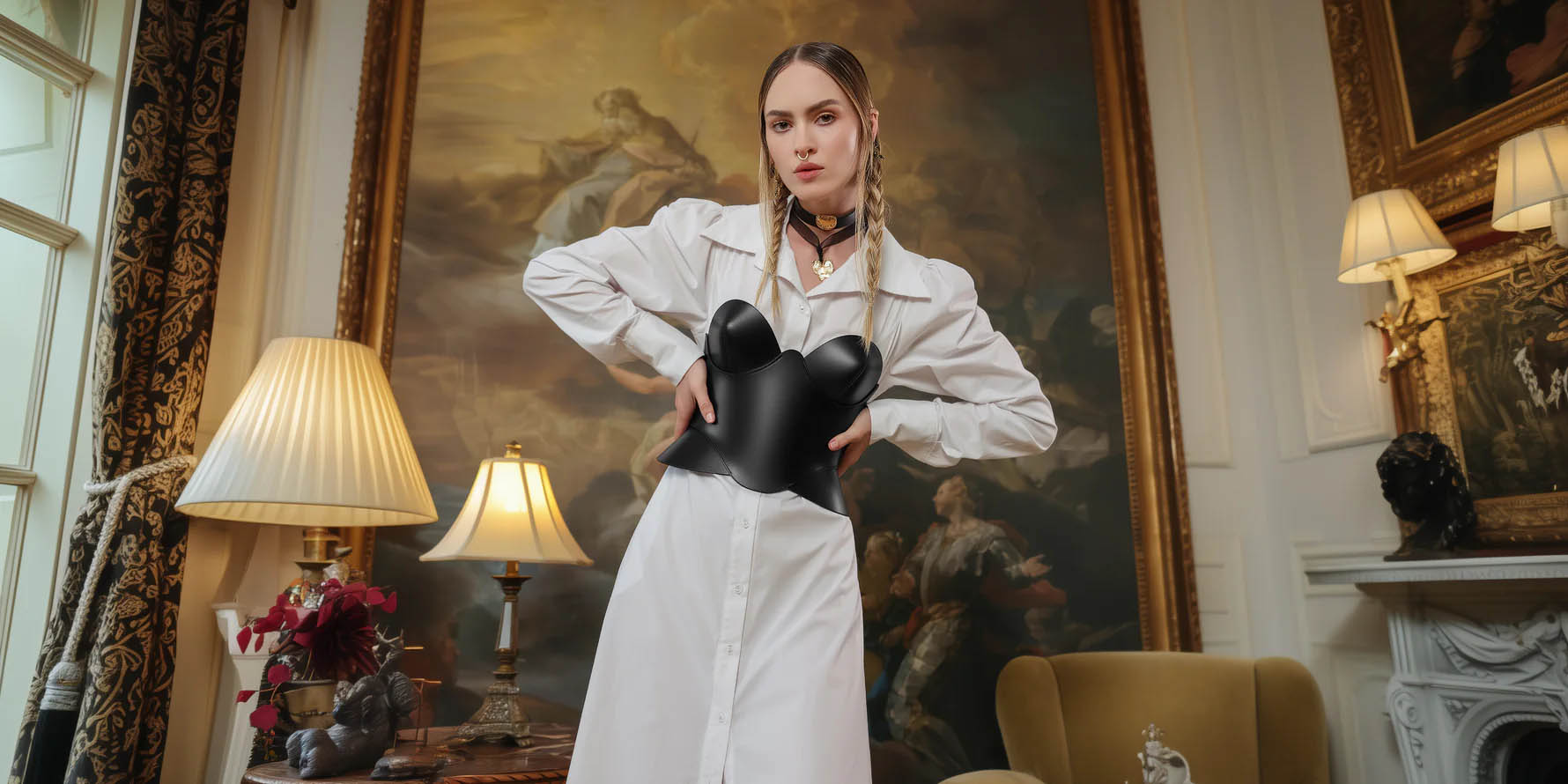
The signature vocabulary is immediately recognizable: wide structured belts that reframe the waist as architecture, leather harnesses that turn the body's geometry into a design problem worth solving, corset belts that arrive somewhere between couture and armor. The collection explores the versatility of leather corsetry, incorporating various silhouettes and unique cut-out patterns. Designed to be both a functional accessory and an artful adornment, these belts redefine femininity through structured lines and tailored shapes.
The dominant material is black — always, emphatically black. "I primarily work with black leather — I feel it truly highlights the essence of what I create," Aiacoboaie has said. This is an aesthetic position, not a limitation. Black leather has a history: it carries the coded languages of subculture, of formality, of severity, of seduction. Aiacoboaie understands all of these registers and operates in the tension between them. His pieces don't belong to any one scene. They belong to a woman who has decided she is done being decorated and would prefer, instead, to be architecturally considered.
The Material Matters: Italian Leather, Romanian Hands
In an era of accelerated fashion — where the distance between a trend and its discount rack moment can be measured in weeks — Haute Cuir moves on a different clock. Pieces like the Prestige Harness are handcrafted using smooth Italian leather, with nickel-plated hardware, designed to be easy to wear and incorporate into any outfit. The sourcing is not accidental. Italian full-grain leather has a particular quality of aging — it develops a patina rather than simply wearing out, which means that a Haute Cuir belt bought today will look different, and arguably better, in three years. This is the quiet economics of quality: you stop replacing things.
The care instructions that accompany Haute Cuir pieces are themselves a kind of education in material respect. The leather should be wiped with a slightly damp cloth and left to dry at room temperature. It should not be exposed to heat, humidity, alcohol, or rough surfaces. These are not inconveniences; they are a relationship. The piece asks something of you in return for lasting.
This is a distinction that matters enormously to the Ce Fain! customer — a buyer who has grown weary of planned obsolescence and is actively seeking objects that reward attention. The Ce Fain! thesis, at its core, is that Romanian makers operate at a quality level that the American luxury market has simply not yet discovered. Haute Cuir is a proof of concept.
Why Romania, Why Now
To understand why Haute Cuir's origins matter — not just as biography but as context — it helps to understand what Romanian craft culture actually is, stripped of the nostalgia that tends to get projected onto it from the outside.
Romania has a serious, sustained tradition of working with leather and textile — a tradition that was not interrupted so much as redirected during the communist period, when skilled artisans were absorbed into industrial production. What survived, and what has re-emerged with particular intensity in the post-accession generation of Romanian designers, is something harder to name than craft: a relationship to material knowledge that is genuinely embodied, passed down through practice rather than printed in manuals. When Aiacoboaie describes his early years with leather as instinctive, he is reaching toward this inheritance even if he doesn't frame it that way. The hands that learned at nineteen were not starting from zero.

This is the deeper argument of Ce Fain! as a platform: not that Romanian design is interesting because it is exotic, but that it is valuable because it is serious. The designers featured here are not making heritage reproductions for tourists. They are making contemporary objects that happen to be grounded in a tradition of material rigor that most American-made luxury goods can no longer claim. Haute Cuir is exemplary in this sense. There is nothing folkloric about a structural leather harness. But there is something distinctly Romanian about the conviction that a handmade object should be indistinguishable from a perfect idea.
The Platform Equation: What Ce Fain! Offers, What Haute Cuir Brings
The partnership is not coincidental. Ce Fain! was built specifically to address a problem that independent Romanian designers face at scale: the American luxury consumer is ready for them, but the infrastructure that would make discovery possible has been missing. A Romanian atelier producing exceptional goods can reach Etsy and Wolf & Badger and Not Just a Label — and Haute Cuir has done all of this, credibly. But what it gains through Ce Fain! is something different: a curated context, a narrative frame, and an audience that arrives pre-educated about Romanian design's particular proposition.
Ce Fain! handles the full American market infrastructure — e-commerce, product presentation, customer service, fulfillment coordination, and the kind of cultural storytelling that transforms a purchase from a transaction into a commitment. For Haute Cuir, this means the pieces can speak for themselves rather than compete in the undifferentiated noise of generalist platforms. For the Ce Fain! customer, it means another access point into a design world that rewards sustained attention.
There is also a timing argument. Ce Fain! launches Haute Cuir as it enters 2026 with significant cultural momentum — a year in which Romania's international profile is elevated by major commemorations, and in which the platform's own Form & Flight program is positioning Romanian design as a living, evolving conversation rather than a museum exhibit. Haute Cuir fits this context with unusual precision. Its aesthetic does not look backward. Its references — structural, architectural, rooted in the body rather than in history — align exactly with the vocabulary of discipline, balance, and timelessness that defines the year's curatorial thrust.
On Wearing Something That Means Something
The late cultural critic John Berger wrote that "the relation between what we see and what we know is never settled." He was writing about painting, but the observation applies to dress with equal force. What we choose to put on the body is never only about covering it. It is a series of small arguments about who we are and what we value, and most of those arguments are made silently, through material and cut.
Haute Cuir's belts and harnesses are unusually honest objects in this regard. They make no attempt to be unobtrusive. They land at the waist or drape across the shoulder with an architectural authority that requires something of the wearer — a willingness to be seen, a comfort with the idea that the accessory is not supplementary but structural. This is not clothing for someone who wants to disappear. It is clothing for someone who has made a decision.
The Ce Fain! customer, broadly speaking, has made a decision too: to buy less, better, from makers whose stories are legible and whose materials are honest. This is a value alignment, not just a taste alignment. And value alignments tend to produce the thing that every platform most needs and least knows how to manufacture: loyalty.
The Invitation
Haute Cuir is available now on Ce Fain! — which is to say, it is available to the American luxury buyer who has been waiting, perhaps without knowing it, for exactly this kind of object. A black leather belt cut from full-grain Italian leather by Romanian hands, structured with the confidence of someone who learned to love the material before they learned to sell it.
Some things take a long time to arrive at the right place. They are worth the wait.
Shop Haute Cuir at cefain.com.
Ce Fain! is the premier curated US marketplace for contemporary Romanian design. We connect discerning American collectors with Romania's most compelling designers across fashion, jewelry, home decor, and art — presenting each maker's work with the cultural depth and commercial infrastructure it deserves.