Raluca Buzura's Porcelain Jewelry: Wearable Art That Fits Like a Second Skin
On the Romanian artist who spent twenty years teaching the most unforgiving material in her studio to do exactly what she wanted.
The sea sponge disappears. That's the point.
Buzura dips it in liquid porcelain until it's saturated, builds a ring around it, fires everything at high temperature. The sponge burns away — completely, cleanly — leaving the porcelain holding the exact shape of what's no longer there. Every pore, every irregular channel of the original structure, preserved as negative space. The ring that comes out of the kiln is a fossil of something that ceased to exist in making it.
This is how Raluca Buzura thinks. Not about jewelry, exactly — about what material does when you push it past its own threshold, and what meaning survives the transformation.

She grew up in Tășnad, in northern Romania, studied ceramics at the University of Art and Design in Cluj-Napoca, and spent her early years making installations. Large-scale work, spatial, theatrical. When she eventually turned to jewelry she didn't abandon that instinct — she compressed it. A necklace became the vehicle for something that had previously required a room. The scale changed; the logic didn't.
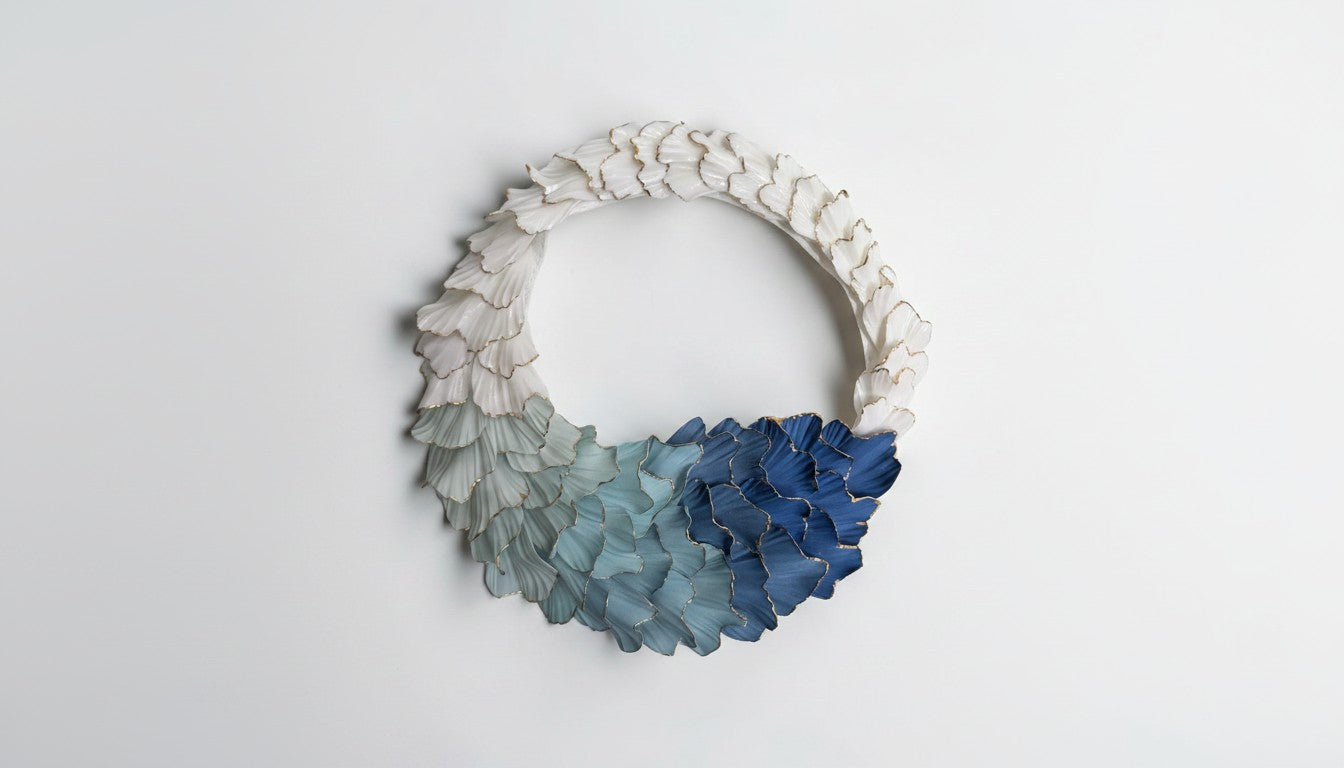
Twenty years of working in porcelain have given her a fluency with the material that reads as almost counterintuitive. Porcelain is brittle, temperamental, catastrophically unforgiving of ambition. It warps. It cracks. It has no interest in being petal-thin, in holding the ghost of a sea sponge, in fanning out across a collarbone in forty individually hand-shaped pieces that graduate from ivory to sky to cobalt. Getting it to do those things requires a sustained, patient argument — which is, it turns out, exactly what her work is about. She has described her preference for ceramics as inseparable from this property: once it has taken a form, it cannot return to what it was before.
The irreversibility is not incidental. It's the whole subject.
A World Built Piece by Piece
Walk through her collections and a world assembles itself — not the natural world photographed and reproduced, but nature processed through twenty years of obsession and then fired into something permanently, irreducibly itself. Flowers with petals so finely modeled they bend at the edges. Sea anemones translated into brooches that look like they just surfaced. Necklaces that span the chest in compositions of layered porcelain elements, each one shaped by hand, assembled with a precision that reads as almost architectural.

The color is part of the argument. High-temperature pigments mixed directly into the porcelain clay allow tonal gradients to emerge through the firing process itself — not painted on afterward, but built in, the color and the form arriving together. Blue blooms from white. Ivory deepens to cream. And then, after the first firing, the gold: colloidal gold applied by hand to specific edges and surfaces, fixed in a second firing. Not gilded in any decorative sense — more like a line drawn to complete a thought.
Her Betta Splendens pieces capture the movement of a fish through water, the fin structure translated into layered porcelain elements in soft blue and white. The Wave Necklace and Coral Reef Necklace come from the same ongoing conversation with the ocean, the same attention to how organic systems build themselves — the layering, the asymmetry, the sense of something still in motion. The Navalles earrings are named for razor clams, white outside, the interior surfaces painted in gold luster that only reveals itself when the angle of light shifts. The Algae earrings have the same quality — matte and restrained until they're not.

The Process
Each piece carries more than a month of accumulated work. It starts with liquid porcelain slip poured into plaster molds, the forms released and then refined by hand: petals cut with a blade to their exact taper, edges smoothed, surfaces glazed with a brush. Once fired, the individual elements — sometimes forty or fifty for a single necklace — are sorted, painted with colloidal gold, and loaded back into the kiln for a second firing to fix it. What comes out then still isn't finished. The gilded porcelain elements get threaded and assembled onto their backing by hand, piece by piece, the composition built up like a mosaic until the whole settles into the form she intended. Every stage is visible in the work. Nothing is hidden.
There is one of most of them in the world.
 |
 |
 |
 |
How They Actually Wear
The visual impact is immediate and obvious. What surprises people who actually wear Buzura's pieces is that they don't feel like what they look like.
Porcelain jewelry has a reputation — heavy, rigid, the kind of thing you put on for photographs and take off before you move. Buzura spent years solving this problem without calling it a problem, through the structural logic of how she builds. Her larger necklaces distribute weight across a backing of white artificial leather that moves with the body. The porcelain elements are individually shaped and assembled so that the composition has flexibility — not the flexibility of fabric, but enough that the piece settles onto the body rather than sitting against it. A necklace that looks like it commands the room turns out to rest on the collarbone with the easy presence of something that was always meant to be there.

The brooches and pins share the same quality. The Lobster Brooch — cast from a real claw, every ridge and joint preserved — wears as a subtle, knowing thing; you have to look twice before you understand what you're seeing.
|
White Lobster Brooch |
Blue Lobster Brooch |
Beta Splendens Brooch |


The Sea Bloom Pin is quieter still: white porcelain, gold-edged, the kind of piece someone notices on you and can't immediately name.

The Betta Splendens Bracelet frames the wrist on a gold-plated brass cuff, the porcelain elements rising from it in a composition that looks precarious and feels, in practice, completely secure.

This is the thing that doesn't come through in photographs: the wearability is not a concession to function. It's an extension of the same thinking that shapes everything else. Buzura comes from installation art, where a work has to inhabit a space without dominating it, has to make itself felt without making itself difficult. Her jewelry does the same thing on the body.
The Record
In 2019, Lladró came to her. Not the other way around — the Spanish porcelain house sought out a single artist working alone in Catalonia because her technical command of the material was that specific. The resulting collaboration, Actinia, won the International Design Award gold medal the following year.
This May, she participated in MAD About Jewelry 2026 at the Museum of Arts and Design in New York — the most significant showcase of contemporary art jewelry in the United States — where she was invited to speak at a luncheon alongside senior curator Barbara Paris Gifford and writer Lynn Yaeger. She first showed at MAD in 2017. SCHMUCK at Munich Jewellery Week, the world's most selective contemporary jewelry exhibition, Porto, Turin, Athens, Tokyo, Rotterdam. The cover of New Necklaces by Nicolas Estrada. Metalsmith Magazine. Vogue Japan.
Awards: International Design Award gold (2020), Joya Barcelona (2019), Milano Fashion & Jewels (2025).
She has shown at AUTOR, Bucharest's international contemporary jewelry fair, every year since 2009 — long before the rest of the world was paying attention.
Buzura was born in Tășnad, Romania. Trained in Cluj. She has been collected internationally for years and we are thrilled to have her here, at Ce Fain!.
Every piece is one of a kind. When it sells, it's gone.
Browse the Raluca Buzura collection exclusively at cefain.com.