Maria Costake Turns Botanical Watercolors Into Silk
Or the illustrator who turned years of botanical work for international brands into a visual language of her own.
Maria Costake paints a peony the way most people would photograph one: close, slow, willing to spend hours on the exact moment a petal catches light. Watercolor first, laid down in thin layers that build toward the final color instead of arriving at it directly. Pencil after, for the veining in a leaf that nobody consciously notices until it's missing. A single study can take days.
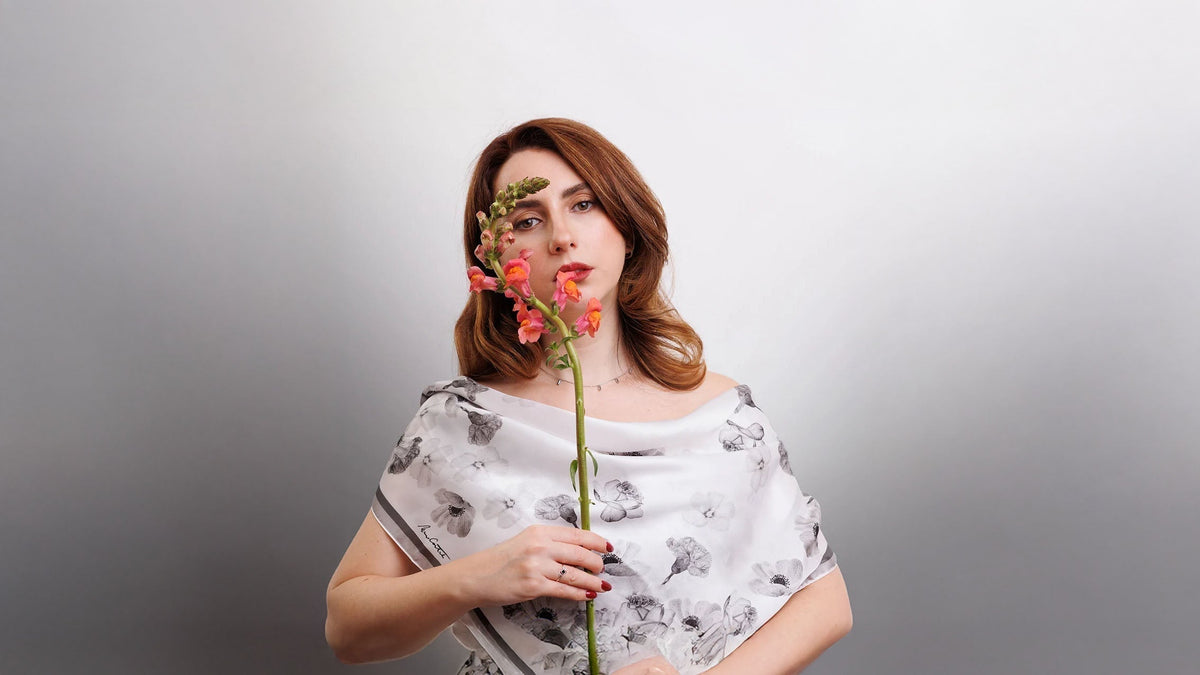
What happens to that painting afterward is the more interesting part. It gets scanned, reproduced on natural silk at a resolution close enough to the original that the brushwork survives the jump, then finished into a scarf. A piece that existed only on Costake's desk in Bucharest ends up around a stranger's neck in another country, still holding the exact gradient of watercolor she mixed by hand.

Costake came up through Colegiul Național Gheorghe Lazăr, one of Bucharest's math and computer science magnet high schools, class of 2015. It's an odd on-ramp into botanical painting, and worth mentioning precisely because it doesn't fit the expected story. From there she went into Graphic Arts at the National University of Arts in Bucharest, and stayed for a master's in the same department. In university she discovered her love for botanical art and focused her work on that. Now she is currently studying the Diploma Course by Society of Botanical Artists.
From 2017 to 2022 she did only freelancer work. Her illustration and pattern design have shown up in campaigns for SwissMed clinic, Salvați Copiii România initiative run in partnership with Mercedes-Benz and the Consulate of Madagascar and Cosulate of Senegal in Bucharest. Further out, a spread of international brands: Kossma Beauty in the US, Parkerview Brews in Canada, Glow in the UK, Banks & Solander in Australia, Mamamonte in South Korea.
Building a brand around botanical art
After years of creating illustrations and surface designs for other brands, Costake wanted to build something that would carry her own visual language from beginning to end. In 2022, that idea became her eponymous brand, with silk scarves as the natural meeting point between botanical illustration, textile design and a lasting object.
The transition was gradual rather than a departure from her previous work. The same watercolor studies and attention to botanical detail remained at the center, but she was now able to decide what happened beyond the painting itself: how an image was translated onto fabric, how the colors were reproduced, how the composition interacted with the format of a scarf, and how the finished piece was presented. What began as an extension of her illustration practice developed into a brand built around wearable botanical art — pieces intended to retain the character of the original watercolor while existing independently as objects of design.

Open Studio
Costake also teaches, through an ongoing series of botanical watercolor workshops. The sessions are built around the same process she uses in her own practice: careful observation, drawing, layering transparent washes and gradually building color and detail.
Rather than focusing only on the finished image, the workshops introduce participants to the way a botanical subject can be translated into watercolor, from studying its structure and proportions to capturing the subtle variations of color, texture and light that give each plant its character.
In June 2024 she opened her first solo exhibition, Grădina Feminității, a collection of botanical watercolors shown at Renaissance Art Gallery.
What's for Sale
Every scarf begins with Costake’s original watercolor work. The flowers and botanical elements are first painted by hand, with the same attention to color, transparency and detail that defines her illustration practice. These paintings then become the starting point for the textile design: they are carefully digitized, composed and adapted to the proportions of the scarf before being reproduced on silk, with particular attention paid to preserving the softness, layering and tonal variations of watercolor.
The result is not simply a pattern created on a screen, but a textile design rooted in an original work made by hand. That connection between traditional botanical painting and a contemporary wearable object remains at the core of Costake’s brand.
Beyond the scarves, her practice continues across several forms. Costake creates and sells original botanical watercolors, fine art prints and illustrated paper goods, while also taking on commissioned illustration projects for brands, interiors and private clients. Whether the final work ends up framed on a wall, incorporated into a visual identity or translated onto silk, the process begins in much the same way: with drawing, watercolor and close observation of the natural subject.
Written for a Different Audience Now
None of this reads as a debut, and it isn't one. It's a decade of paid client work and a growing personal practice meeting in the same place, which tends to be what makes a maker worth paying attention to in the first place. After years of creating work for international brands, Costake turned that experience toward something more personal: a collection built around her own name, imagery and artistic language. Ce Fain! is where they reach a US audience for the first time.
Shop the silk scarf collection on Ce Fain!